
Quick answer: Climbing taxes your lungs. Descending taxes your muscles. Every downhill step forces your quads and calves to absorb your body weight while they lengthen, and that type of loading is the one most associated with muscle damage. In one study, runners lost about a fifth of their knee extensor strength after a single all-out 6.5 km descent. The good news: legs show a protective response to repeated downhill exposure, but only if you actually give them some, and only in doses they can handle. The evidence comes mostly from small studies, so treat it as a sensible direction, not a guarantee.
Ask most trail runners how they train for a mountain race and you will hear about climbing. Hill repeats, stair sessions, power hiking. The descent gets treated as the reward, the part where you "recover."
Ask those same runners where the race fell apart and the answer is often different. Quads that will not lift the knee. Calves that cramp on the way down. A final 10 km that turns into a shuffle. Often, that is the descent catching up with legs that were never prepared for it.
This article covers what happens in your legs on a downhill, what the research says about preparing for it, and a cautious way to start. We do not have data showing that most runners neglect downhill training, so treat that as our observation, not a statistic. What the science does show is that the descent has its own cost, and the climb does not pay it for you.
Why a descent hurts differently from a climb
On a climb, your muscles shorten while they produce force. The effort is high, and your heart rate and breathing show it.
On a descent, your quads and calves do the opposite. They produce force while they lengthen, braking your body against gravity with every stride. This is called eccentric loading. It is metabolically cheap, so you can feel comfortable while it happens. It is also the kind of contraction most associated with muscle fibre damage.
A 2017 review in Sports Medicine found that the energy cost of running rises steadily with uphill gradient, while on downhills it falls until around a 20% descent before rising again. In downhill running, muscles absorb more energy than they generate. The same review noted that uphill running demands more overall muscle activity than level or downhill running. So the climb is harder on your engine. The descent is harder on your muscle tissue.
That difference is why downhill running can feel easy at the time and leave you wrecked the next day.
What a single descent does to your legs
The clearest data comes from trail runners tested straight after real downhill running.
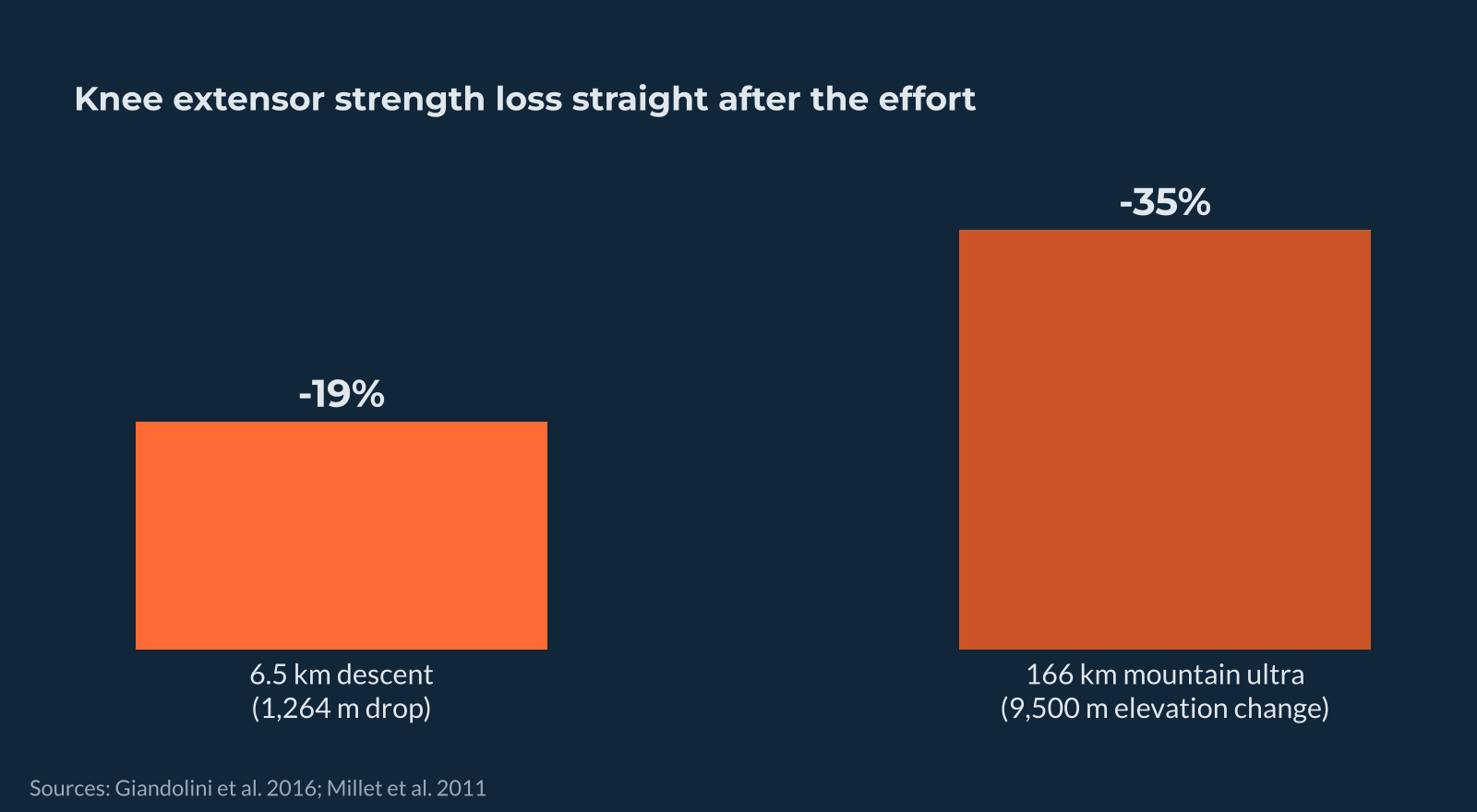
In a 2016 study, 23 runners ran a 6.5 km downhill trail with a 1,264 m drop as fast as they could. Straight afterwards, maximal knee extensor strength was down about 19% and calf (plantar flexor) strength was down about 25%. Two days later both were still down by roughly 9% to 10%.
At the extreme end, runners in a 166 km mountain ultramarathon, which had 9,500 m of positive and negative elevation change, lost around 35% of knee extensor strength and 39% of calf strength. Creatine kinase, a blood marker of muscle damage, rose from about 144 to over 13,000 UI/L on average. Most neuromuscular recovery came within 9 days, with full return by 16 days.
Reviews of controlled downhill studies add useful numbers. Strength loss in the knee extensors varies widely between studies, from about 14% to 55%. Soreness and creatine kinase typically peak 24 to 48 hours later, and markers of damage fade over roughly 4 to 10 days. In one study cited by the review, running economy stayed altered for up to 3 days after 30 minutes of downhill running.
In plain terms: one hard descent can cost you several days of full-strength legs. If that descent comes late in a race, or in the middle of a stage race, you carry it forward.
The honest nuance: overall fatigue tracks duration
It would be neat to say the downhills cause most of the fatigue in a trail race. The research does not quite say that.
A 2016 review compared prolonged hilly running with prolonged level running. The overall pattern of neuromuscular fatigue was similar, and duration rather than elevation change was the main driver. Pure downhill running, by contrast, produces large rises in markers of muscle damage and inflammation, and that is where the tissue damage comes from.
So the fair summary is this. A long race tires you out mostly because it is long. The descents add a separate kind of damage on top, one that shows up as stiffness, soreness and a loss of strength that lingers after the finish line. If you want your legs to hold together in the late miles and recover well afterwards, the descent is where preparation looks most useful.
Why the legs, more than the lungs, set the limit
Another reason runners underestimate descents is that the engine is not what limits you. In a study of eight well-trained trail runners, peak oxygen uptake on a steep -15% descent was about 16% to 18% lower than on the flat, so they could not push their cardiovascular system to its maximum. In a separate study of 10 highly trained men, maximal leg extensor strength helped predict both 5 km downhill and uphill time trial performance, alongside aerobic fitness and, for the downhill, leg stiffness.
The takeaway: on steep descents, effort can feel metabolically easy while the mechanical load on your legs is high. Your muscles and tendons are the part that has to cope.
How legs adapt: the repeated bout effect
Here is the encouraging part. Muscles protect themselves after a damaging bout of eccentric exercise. The second time you do something similar, you get less soreness and less strength loss. This is known as the repeated bout effect.
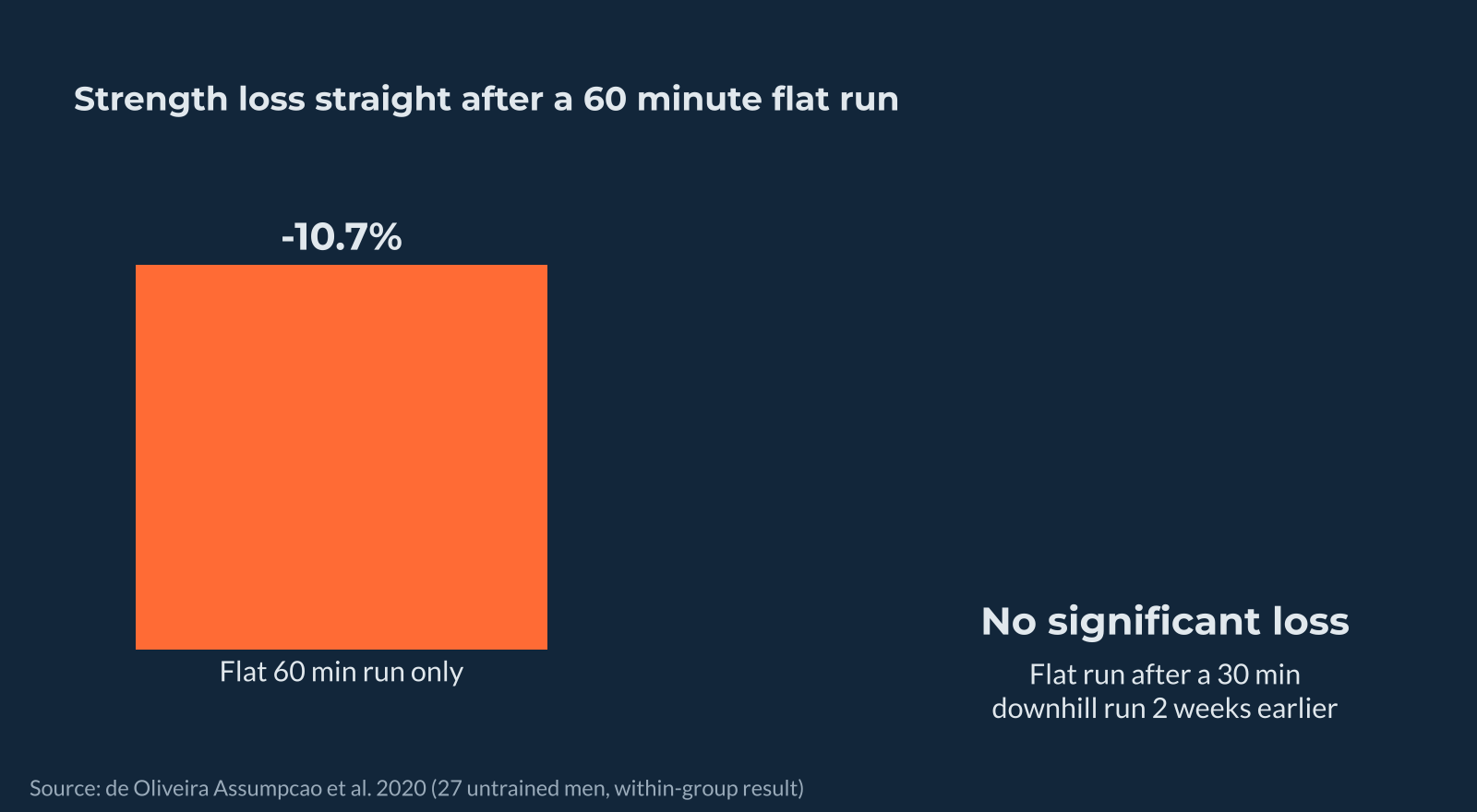
In a 2020 study, 27 male college students with no systematic training in the previous six months did a 30 minute run at a -15% gradient. Two weeks later, everyone ran 60 minutes on the flat. The control group lost about 11% of their strength during the flat run. In the group that had done the earlier downhill run, the loss was not statistically significant. The paper did not report a significant difference between the two groups at any time point, so treat this as a promising signal, not proof.
A separate study had 10 recreational runners do two 30 minute sessions at -20%, three weeks apart. The second session produced less soreness, a smaller rise in creatine kinase and less strength loss.
Both studies used only male participants, in lab conditions and at doses that would be too much for a beginner. Use them as proof that the effect exists, not as a training plan.
What preparation can and cannot do
A 2025 study of 12 adults without recent eccentric training ran 10 progressive treadmill downhill sessions across two blocks. After 10 sessions, quadriceps soreness from a standard 15 minute test was lower than at baseline. Strength loss after the same test fell from about 14% to about 9%, but that change was not statistically significant.
The practical reading: in this small study, preparation lowered soreness, while any protection for strength was unclear. Reviews of the field also note that the protective effect fades. In one study, the benefit from a 30 minute bout had disappeared after 9 weeks with no eccentric work. And across the research, the people least used to downhill running tended to suffer the most damage.
Other tools get mixed results. A review rated compression garments as having the most potential, but the evidence is limited. The review found no demonstrated influence of footwear on adaptation to downhill running, and the evidence on changing your stride is thin, so we would not build a plan around either.
Try this week
This is general guidance built from the research above, not a prescription from any of the studies. Lab protocols used 30 minutes at steep gradients in young male participants. Do not copy them.
A gentle start: Add 5 to 10 minutes of easy, controlled downhill running or fast hiking to one run this week, on a gradual slope you can handle without braking hard. Keep the effort conversational. If your quads are still sore two days later, repeat the same dose next week, not more. Build duration and gradient slowly over several weeks.
Some other guidelines worth following:
Keep exposure regular. In one study the protective effect had gone after 9 weeks without eccentric work, so our inference is that a single big session two months before a race will not do much.
Avoid new, hard downhill work in the last week before a key race. Strength loss and soreness from a damaging descent can last 4 to 5 days or longer. This is our inference from the research on recovery time.
Practise the skill too. Short, quick steps and a relaxed upper body help you stay in control. This is coaching practice rather than a finding from the studies above.
If you have knee, ankle, hip or other injury or health concerns, speak to a doctor, physio or coach before adding downhill work. It loads the joints and tendons as well as the muscles.
Where this fits in your training
Downhill conditioning is one part of a bigger picture. If you have not read it yet, our piece on why pace zones do not work on trails covers how to judge effort when gradient changes everything. For fuelling the long days these descents come in, see running nutrition: what you actually need to eat.
Elite You builds training plans around vert, technicality and altitude, and syncs your completed sessions from Strava and Garmin, so you can see how your weeks of climbing and descending add up.
Sources
- Vernillo G, et al. Biomechanics and physiology of uphill and downhill running. Sports Med. 2017;47(4):615-629. doi:10.1007/s40279-016-0605-y
- Giandolini M, et al. Fatigue associated with prolonged graded running. Eur J Appl Physiol. 2016;116(10):1859-1873. doi:10.1007/s00421-016-3437-4
- Giandolini M, et al. Acute and delayed peripheral and central neuromuscular alterations induced by a short and intense downhill trail run. Scand J Med Sci Sports. 2016;26(11):1321-1333. doi:10.1111/sms.12583
- Millet GY, Tomazin K, Verges S, et al. Neuromuscular consequences of an extreme mountain ultra-marathon. PLoS ONE. 2011;6(2):e17059. doi:10.1371/journal.pone.0017059
- Bontemps B, Vercruyssen F, Gruet M, Louis J. Downhill running: what are the effects and how can we adapt? A narrative review. Sports Med. 2020;50(12):2083-2110. doi:10.1007/s40279-020-01355-z
- de Oliveira Assumpção C, et al. A single bout of downhill running attenuates subsequent level running-induced fatigue. Sci Rep. 2020;10:18809. doi:10.1038/s41598-020-76008-2
- Khassetarash A, Vernillo G, Kruger RL, Edwards WB, Millet GY. Neuromuscular, biomechanical, and energetic adjustments following repeated bouts of downhill running. J Sport Health Sci. 2022;11(3):319-329. doi:10.1016/j.jshs.2021.06.001
- Bontemps B, et al. Muscle soreness but not neuromuscular fatigue responses following downhill running differ according to the number of exercise bouts. Eur J Sport Sci. 2025;25(3):e12240. doi:10.1002/ejsc.12240
- Lemire M, et al. Trail runners cannot reach VO2max during a maximal incremental downhill test. Med Sci Sports Exerc. 2020;52(5):1135-1143. doi:10.1249/MSS.0000000000002240
- Lemire M, Hureau TJ, Favret F, et al. Physiological factors determining downhill vs uphill running endurance performance. J Sci Med Sport. 2021;24(1):85-91. doi:10.1016/j.jsams.2020.06.004
- Ehrström S, Gruet M, Giandolini M, Chapuis S, Morin JB, Vercruyssen F. Acute and delayed neuromuscular alterations induced by downhill running in trained trail runners: beneficial effects of high-pressure compression garments. Front Physiol. 2018;9:1627. doi:10.3389/fphys.2018.01627