
You head out for an easy run on your local trail. Your watch shows 7:30 per km on the flat, 14:00 per km on the main climb and 6:00 per km on the descent.
Which of those paces was easy? By road logic, only one of them sits in your zone. By trail logic, they could all have been the same effort.
Pace zones were built for flat, predictable ground. Trails are neither. This article explains why pace breaks down off-road and what to use instead.
Quick answer: Pace tells you how fast you moved, not how hard you worked. On trails, gradient, terrain, altitude and fatigue all change the pace a given effort produces. Train by effort (RPE), measure load with time and vert, and treat pace as something you review afterwards, not something you chase.
Pace zones were built for flat ground
Pace zones are commonly built from a recent race or time trial, usually on a road or track. Your 10K time sets a threshold pace, and the easy, tempo and interval paces are calculated from it.
That works when conditions stay steady: same surface, same gradient, similar temperature. Change any one of them and the number stops meaning what it says.
A trail can change all of them inside a single kilometer.
Hills change the cost of every step
In a well-known study, Alberto Minetti and colleagues measured the energy cost of running on a treadmill across gradients from steep downhill to steep uphill.
On the flat, running cost about 3.4 joules per kilogram per meter. At a 45% uphill gradient it rose to about 18.9, more than five times higher.
Downhill is less obvious. At a 20% descent the cost dropped to roughly half of the flat value. On steeper descents it climbed again, reaching about 3.9 at 45% downhill, a little above the flat value.
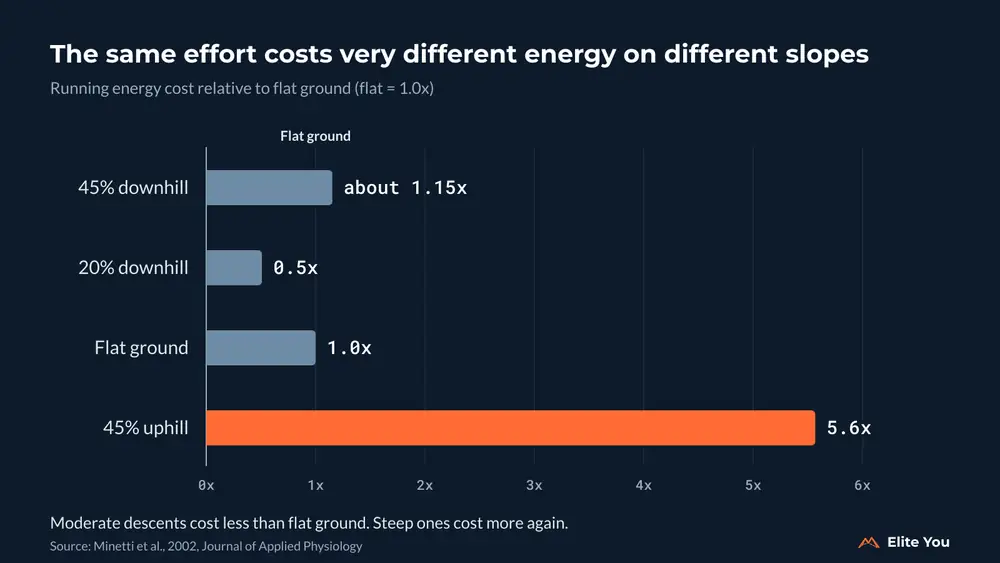
The same effort produces very different speeds depending on the slope. Pace is only the result.
Grade adjusted pace helps, but only so far
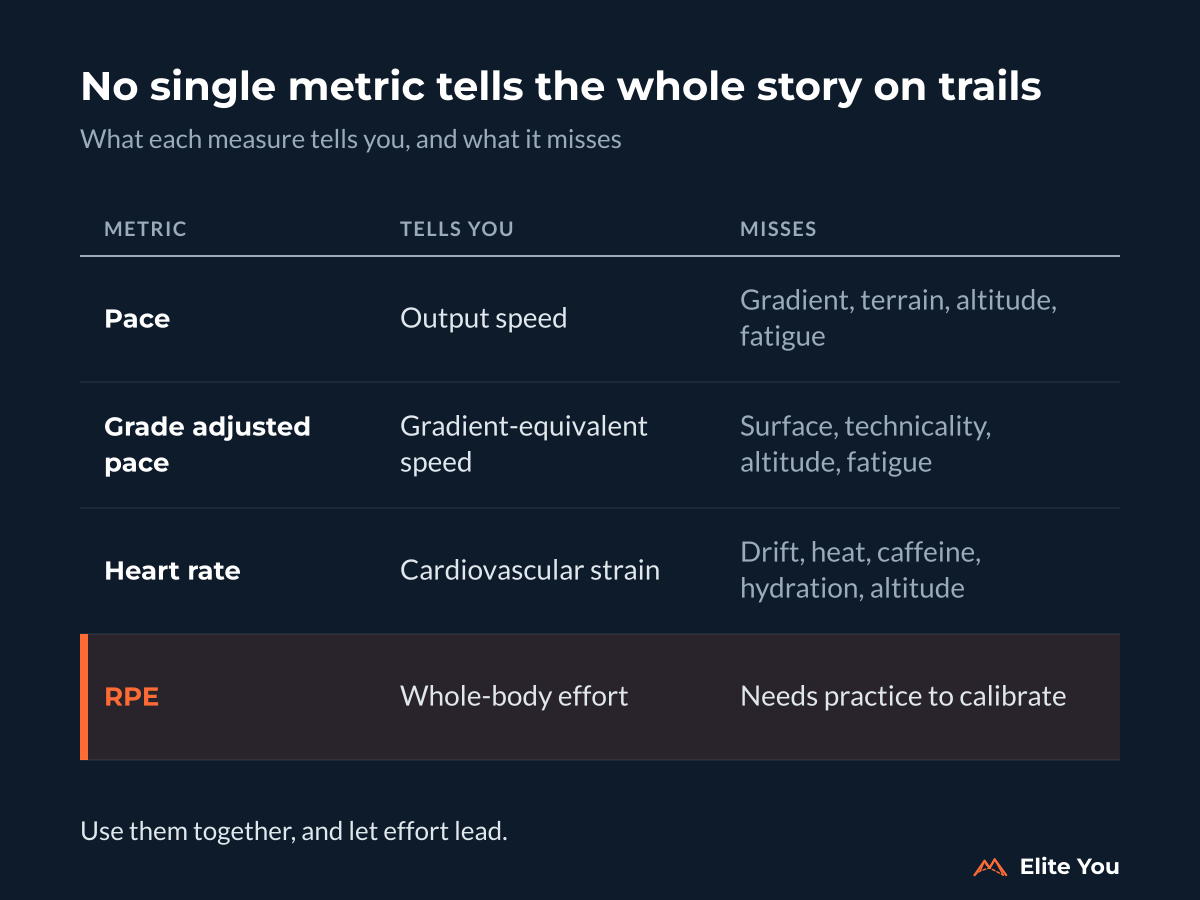
Grade adjusted pace (GAP) is the usual fix. It estimates the flat-ground pace that would match the effort of your hilly run, using research that includes Minetti's work.
It's a useful way to compare hilly runs, but it has limits. Strava's own help pages say it does not account for terrain differences or the technical difficulty of running downhill. When Strava updated its model in 2013, its engineers also said that on descents, technical skill and motor control are almost always the limiting factor, not aerobic fitness.
COROS says the same about its Adjusted Pace: it can't account for trail technicality or terrain differences.
GAP only knows about gradient. Rocks, roots, mud, sand and stream crossings don't register.
Terrain, altitude and fatigue move the target
Two stretches with the same gradient can demand very different paces. A smooth fire road and a rocky, rooty singletrack might be equally steep, but you won't run them at the same speed for the same effort.
Altitude adds another layer. In a hypobaric chamber study, Jon Wehrlin and Jostein Hallén tested eight male endurance athletes on acute exposure to simulated altitudes from 300 to 2,800 meters.
VO2max fell by about 6.3% per 1,000 meters, and time to exhaustion at a hard, fixed speed fell by about 14% per 1,000 meters. The declines began as early as 300 to 800 meters.
A pace zone set at sea level is a harder effort when you first arrive at altitude, even on a flat trail.
Then there's fatigue. Four hours into a long run, the pace that felt easy in the first hour tends to cost more. The zone hasn't changed. You have.
Heart rate isn't the fix either
The common answer is to use heart rate instead. It solves part of the problem, but it brings its own.
During prolonged steady exercise, heart rate tends to creep up even when the pace doesn't change, a pattern known as cardiovascular drift. Body temperature, caffeine, nerves, hydration, altitude and accumulated fatigue can also move it independently of how hard you're actually working, as CTS coach Cliff Pittman explains.
CTS head coach Jason Koop adds that heart rate response to the same exertion is different at high altitude, and that a tired athlete often sees heart rate climb more slowly. In his view, heart rate isn't reliable or predictable enough to be an effective training tool for ultrarunners.
Pittman's framing is useful: heart rate measures cardiovascular strain, pace measures output, and neither tells the whole story alone.
What to train by instead
Trail runners need a measure that combines gradient, terrain, conditions and fatigue. Rate of perceived exertion (RPE) does that, because your body is already integrating all of it.
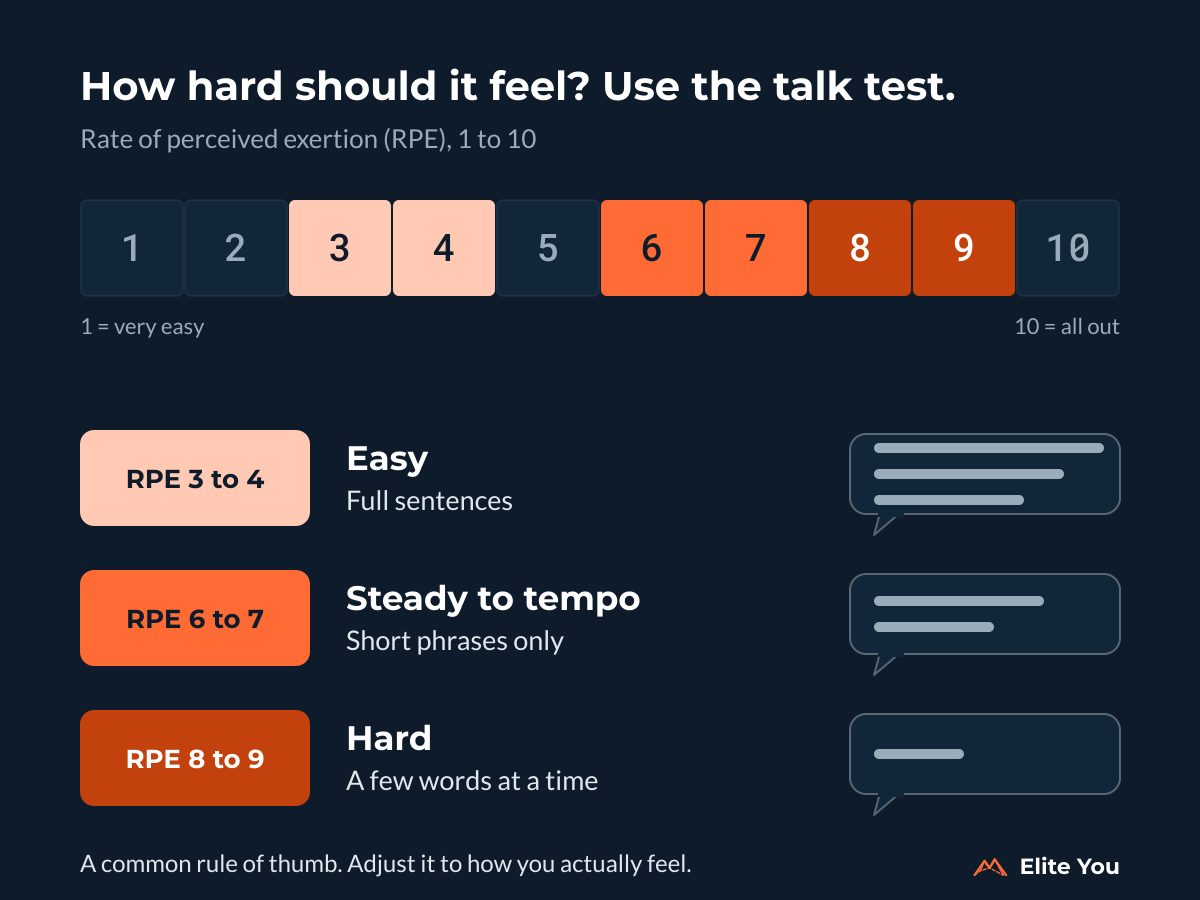
1. Effort (RPE). Rate effort from 1 to 10 and use the talk test as a guide:
- RPE 3 to 4 (easy): you can speak in full sentences.
- RPE 6 to 7 (steady to tempo): short phrases only.
- RPE 8 to 9 (hard): a few words at a time.
These bands are a common rule of thumb, so adjust them to how you actually feel.
2. Load (time and vert). Measure training by hours on your feet and meters climbed, not just kilometers. Ten kilometers on a mountain and ten kilometers on a road are different workouts.
3. Context. Log the terrain, temperature and altitude with each run. A slow pace makes sense once you know the conditions.
4. Pace as a review tool. Look at pace after the run to spot trends. Don't use it to steer in real time.
Try this week
Pick a 60 to 90 minute route with some climbing. Run it at RPE 3 to 4 the whole way, hiking steep sections when you need to keep the effort easy.
Afterwards, compare your pace on the flat, the climbs and the descents. Notice how wide the spread is while the effort stayed the same.
Do the same route again in two weeks. If your pace on the same sections improves at the same RPE, that's real progress, and no pace zone was needed to see it.
How Elite You approaches this
Elite You builds training plans around vert, technicality and altitude, with sessions expressed by effort (RPE) rather than generic pace zones. It syncs your runs from Strava and Garmin and analyzes roughly your last eight weeks of synced running.
FAQ
Is grade adjusted pace accurate on trails?
It's a reasonable way to compare hilly runs, but it only adjusts for gradient. Surface, technicality, altitude and fatigue aren't included, so treat it as a rough guide.
Should I train by heart rate on trails?
Use it as one data point, not the target. Heat, hydration, altitude and fatigue can all shift your heart rate without changing your workload, so pair it with RPE.
What is RPE?
Rate of perceived exertion is how hard the effort feels, on a scale of 1 to 10. It reflects everything your body is dealing with at that moment, which is why it suits variable terrain.
Do I ever need pace on trails?
Yes. It's useful for reviewing runs, comparing similar routes and estimating race times. The point is to stop treating it as the target during the run.
Sources
- Minetti, A.E., Moia, C., Roi, G.S., Susta, D., Ferretti, G. (2002). Energy cost of walking and running at extreme uphill and downhill slopes. Journal of Applied Physiology, 93(3), 1039 to 1046. doi.org
- Strava Engineering (2013). Improving Grade Adjusted Pace.
- Strava Support. Strava Training Glossary for Running.
- COROS Support. Adjusted Pace.
- Coyle, E.F., González-Alonso, J. (2001). Cardiovascular drift during prolonged exercise: new perspectives. Exercise and Sport Sciences Reviews, 29(2), 88 to 92. Link
- Wehrlin, J.P., Hallén, J. (2006). Linear decrease in VO2max and performance with increasing altitude in endurance athletes. European Journal of Applied Physiology, 96(4), 404 to 412. doi.org
- Koop, J. Why Heart Rate Is Not a Good Training Tool for Ultrarunning. CTS.
- Pittman, C. Why Heart Rate and Pace Fail on Trails. CTS Ultrarunning Podcast.
This article is general guidance, not medical advice. If you have a health condition, are returning from injury or are increasing your training load significantly, speak to a doctor or qualified coach first.