
Most runners fuel by feel, or by copying whatever worked for someone else. Your body doesn't work that way. It has specific needs, they scale with your training load, and they're easy to estimate once you know the building blocks. This guide covers each macronutrient, why carbohydrate and glycogen deserve the most attention, and a worked example for a 75 kg runner on a 10 km day.
Quick answer: Carbohydrate is the fuel that keeps hard days repeatable, because muscle glycogen is rebuilt from carbohydrate and not from fat. For a run of about an hour, sports nutrition guidelines point to roughly 5 to 7 g of carbohydrate per kg of body weight per day, 1.2 to 2.0 g/kg of protein, and typically 20% to 35% of energy from fat. Hit your fibre and micronutrient targets with real food, and count the EPA and DHA in your fish oil, not the total grams.
Start with energy, then split it into macros
Calories are the budget. Carbohydrate, protein and fat are how you spend it. If total energy is too low, no macro split will fix your training, and low energy availability, where intake falls short of what training uses once the body's basic needs are covered, is linked to hormonal disruption, poorer bone health, slower recovery and weaker training adaptation.
Position statements from the American College of Sports Medicine and partner organizations express carbohydrate and protein targets in grams per kilogram of body weight. That makes sense: a 55 kg runner and a 90 kg runner on the same percentage split will end up with very different amounts of carbohydrate. This guide uses g/kg for those two, and percentages for fat.
One caveat on age: that position statement is from 2016, and guidance for ultra and trail running has developed since. Costa and colleagues' 2019 review of nutrition for ultramarathon running on trail, track and road, and the International Society of Sports Nutrition's 2025 position stand on long-chain omega-3s, add to it where they are relevant below.
Carbohydrate and glycogen: the backbone of training
What glycogen is
Glycogen is how your body stores carbohydrate. Muscles keep it to fuel their own work, and the liver keeps it to hold blood glucose steady. The stores are limited, which is why a hard session on Tuesday can leave you flat on Wednesday if you haven't refilled them.
Why it matters for running
Carbohydrate helps maintain blood glucose during exercise and replaces muscle glycogen. Low carbohydrate availability is associated with reduced work rates and impaired training intensity and duration. Consistent, effective training comes from arriving at each session with the tank refilled.
How glycogen gets rebuilt, and what doesn't rebuild it
Muscle glycogen is rebuilt from the carbohydrate you eat. After a hard session, the sports nutrition position statement suggests about 1.0 to 1.2 g of carbohydrate per kg of body weight per hour for the first 4 hours when you need rapid recovery, for example when you train again in 8 hours or less (some guidance extends this to 6 hours). For a 75 kg runner, that's 75 to 90 g of carbohydrate each hour, which is a lot of food, so easy-to-eat carbohydrate such as rice, bread, fruit or a sports drink helps.
With a full day between sessions the maths is relaxed. Glycogen stores can be normalised with about 24 hours of reduced training and adequate fuel intake, so the day's total matters more than the exact timing.
Fat is the part runners get wrong. Eating more fat does not refill glycogen. Biochemistry textbooks state that fatty acids cannot be converted into glucose in animals, because the acetyl CoA that fat breakdown produces cannot be turned back into pyruvate. A 2011 computational study did propose possible routes in humans, but it describes the standard view as a general consensus. In practice, fat can fuel your muscles during easy running, but it isn't what rebuilds the carbohydrate store that harder running draws on. Protein taken with carbohydrate can enhance glycogen repletion, but carbohydrate does the main work. If tomorrow's run matters, the carbohydrate in today's dinner is what counts.
How much carbohydrate you need
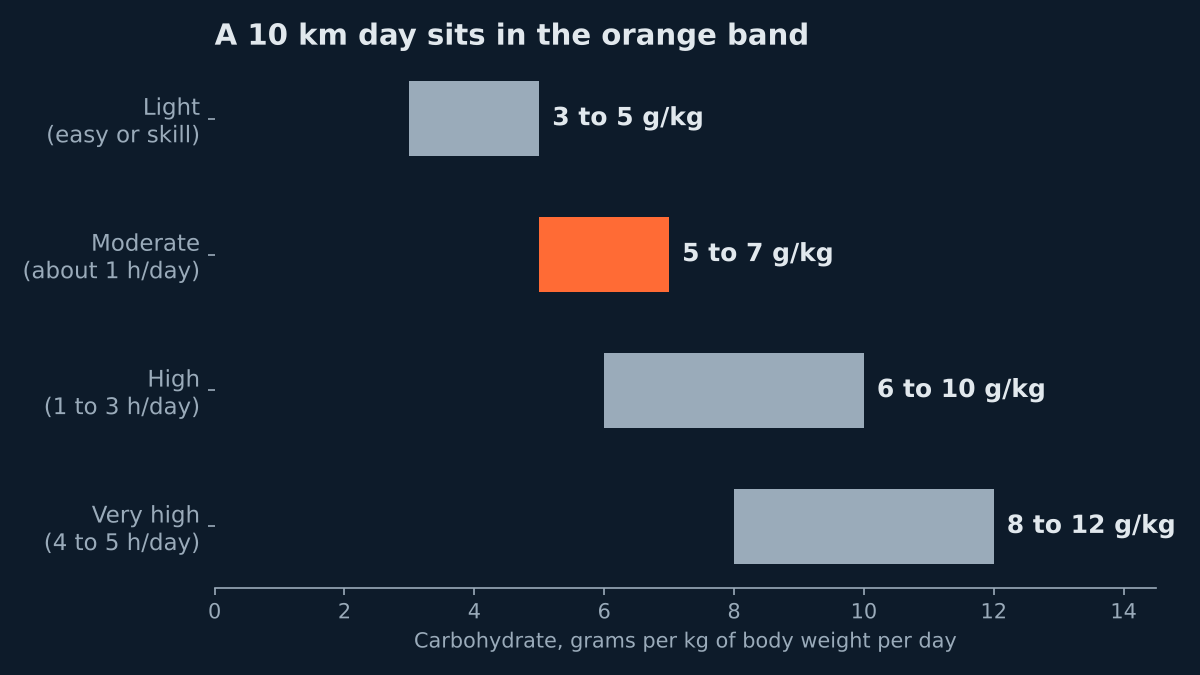
Guidelines scale carbohydrate with training load. Find your day in the table, then multiply by your body weight.
| Training load | Carbs (g/kg/day) | For 75 kg |
|---|---|---|
| Light (skill or easy days) | 3 to 5 | 225 to 375 g |
| Moderate (about 1 hour a day) | 5 to 7 | 375 to 525 g |
| High (1 to 3 hours a day) | 6 to 10 | 450 to 750 g |
| Very high (4 to 5 hours a day) | 8 to 12 | 600 to 900 g |
For someone running most days, a carbohydrate-heavy diet is the plan, fine-tuned to total energy needs.
Protein and fat: the supporting roles
Protein repairs and rebuilds muscle. The position statement gives 1.2 to 2.0 g/kg per day, with modest doses of high-quality protein (about 0.25 to 0.3 g/kg, roughly 20 g for a 75 kg runner) spread through the day and soon after hard sessions.
Fat carries essential fatty acids and fat-soluble vitamins, and it supplies energy. Intakes of 20% to 35% of total energy are typical for athletes, and the position statement says intakes of 20% or less do not benefit performance. Whatever energy remains after your carbohydrate and protein targets is typically where fat lands.
Fibre and micronutrients
Fibre keeps digestion regular. The adequate intake for men aged 19 to 50 is 38 g per day, which is based on 14 g per 1,000 calories. Heavy training days push calories up, so a calorie-based target rises with them. Closer to a run, lower-fibre carbohydrate such as white rice, toast or a banana tends to sit more comfortably.
Micronutrients are vitamins and minerals. The position statement says supplements are generally unnecessary when your diet provides high energy availability from a variety of nutrient-dense foods, and may be appropriate in some cases when it doesn't. The reference values below are general adult intakes for men and women, not athlete-specific ones, so treat them as a rough check on your food. Sodium also has a level above which intake should be reduced. If you suspect low iron or vitamin D, ask your doctor for a blood test instead of guessing.
| Nutrient | Adult male reference (aged 31 to 50) | Adult female reference (aged 31 to 50) | Type |
|---|---|---|---|
| Iron | 8 mg | 18 mg | RDA |
| Zinc | 11 mg | 8 mg | RDA |
| Magnesium | 420 mg | 320 mg | RDA |
| Calcium | 1,000 mg | 1,000 mg | RDA |
| Vitamin D | 15 mcg (600 IU) | 15 mcg (600 IU) | RDA |
| Vitamin B12 | 2.4 mcg | 2.4 mcg | RDA |
| Vitamin C | 90 mg | 75 mg | RDA |
| Potassium | 3,400 mg | 2,600 mg | Adequate intake |
| Fibre | 38 g | 25 g | Adequate intake |
| Sodium | 1,500 mg, and reduce intake if above 2,300 mg | 1,500 mg, and reduce intake if above 2,300 mg | Adequate intake and chronic disease risk reduction level |
Age ranges matter. The female iron value of 18 mg applies to women aged 19 to 50, and the calcium and vitamin D values also cover that span. Zinc 8 mg, vitamin B12 2.4 mcg and vitamin C 75 mg apply to adult women generally (not pregnant or breastfeeding), and potassium 2,600 mg to women aged 19 and over. Magnesium is 320 mg for women aged 31 to 50 (310 mg at 19 to 30), and the 25 g fibre value covers women aged 19 to 50.
Sodium is a general population value. Those figures are not tuned to someone sweating through long sessions. The 2016 position statement says sodium should be ingested during exercise when large sweat sodium losses occur, for example with high sweat rates, salty sweat or exercise lasting more than 2 hours, so heavy sweaters in long sessions may need more than the table suggests. It doesn't give an hourly sodium amount, and neither do we.
For female runners, two issues deserve extra attention. Low energy availability was first studied in women, and the position statement links chronic low availability to menstrual dysfunction and a higher risk of low bone density and stress fractures. On iron, the NIH notes that menstrual blood loss raises losses in menstruating women, and the position statement says iron requirements for female athletes may be up to 70% higher and names distance runners among those at greatest risk. If you're tired, flat or struggling to recover, ask your doctor for a blood test rather than supplementing blind.
Omega-3: count the EPA and DHA, not the fish oil
Fish oil labels advertise big numbers, but the fatty acids that matter are EPA and DHA, the long-chain omega-3s found in oily fish. The total oil in a capsule includes other fats. A typical 1,000 mg fish oil capsule provides about 180 mg EPA and 120 mg DHA, so 300 mg of the 1,000 mg is the part you're after, and products vary widely. Read the "per serving" EPA and DHA lines on the label and add them up.
There's no official intake target for EPA and DHA in the US reference values. The International Society of Sports Nutrition's 2025 position stand says athletes may be at higher risk of omega-3 insufficiency, and that EPA and DHA supplementation has been shown to enhance endurance capacity and cardiovascular function during aerobic-type exercise. But the same paper says the direct impact on endurance performance remains inconsistent, that higher doses may be needed for any performance effect, and that more high-quality research is warranted. It does not set a dose for runners. The International Olympic Committee's 2018 consensus statement lists about 2 g a day of omega-3 in a table of supplements that may help with recovery, muscle soreness and injury management, not endurance performance. It adds that supplementation is low risk but it is unclear whether athletes should pursue it instead of eating fatty fish, and that the best recommendation may be to include fatty fish in the diet. The Australian Institute of Sport rates fish oil in its Category B, meaning emerging scientific support. Treat supplements as an optional extra to fill a food gap, not a requirement.
At 300 mg per capsule, even 1 g of EPA and DHA takes three to four capsules, which is why food counts. A 3 oz (about 85 g) serving of cooked farmed Atlantic salmon provides about 1.8 g of EPA and DHA, and canned sardines provide about 1.2 g. The FDA has concluded that supplements providing up to 5 g per day of EPA and DHA are safe when used as recommended, though the NIH notes some trials linking 4 g per day to a slightly higher risk of atrial fibrillation. If you take blood thinners or have a medical condition, check with your doctor first.
Worked example: a 10 km day
Here's a target for a male runner who weighs 75 kg, stands 175 cm tall and runs 10 km in about an hour. We've assumed he's 35 and has an ordinary active day outside training. These are estimates, so adjust them against how you feel and how your weight and training respond.
How the calories were estimated
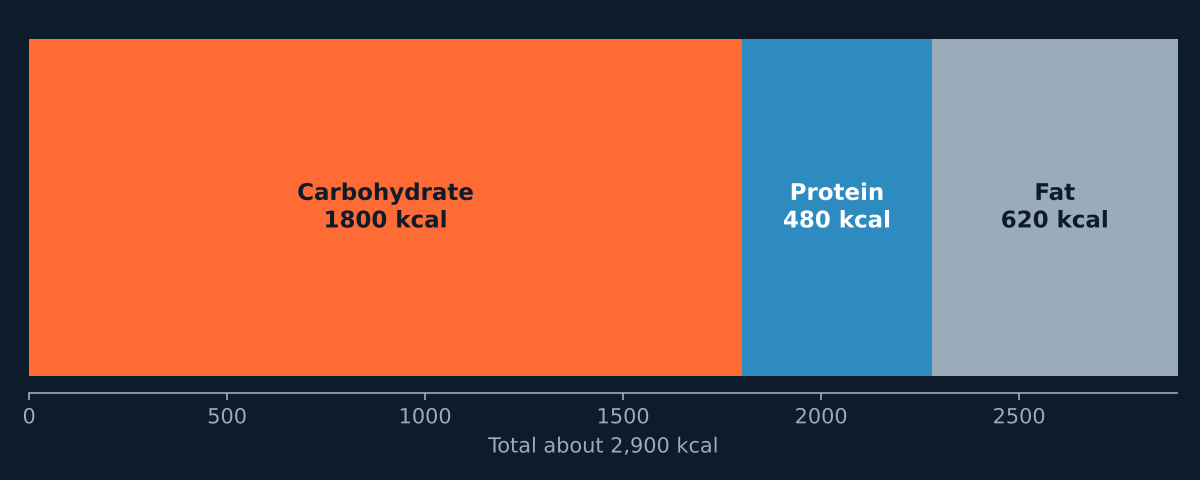
Resting energy comes from the Mifflin-St Jeor equation: 10 x 75 + 6.25 x 175 minus 5 x 35 + 5 = about 1,674 kcal. We multiplied that by 1.35 to cover daily life, which is an assumption and gives roughly 2,260 kcal. The run itself adds about 620 kcal: the Compendium of Physical Activities rates running at 6 to 6.3 mph (10 minutes per mile) at 9.3 METs, and subtracting the 1 MET of resting energy leaves 8.3 x 75 kg x 1 hour. That totals about 2,880, rounded to 2,900 kcal.
| Target | Amount | How we got there |
|---|---|---|
| Energy | about 2,900 kcal | Estimate described above |
| Carbohydrate | about 450 g (62% of energy) | 6 g/kg, middle of the 5 to 7 range |
| Protein | about 120 g (17%) | 1.6 g/kg, inside the 1.2 to 2.0 range |
| Fat | about 70 g (21%) | Remaining energy, inside the typical 20% to 35% range |
| Fibre | about 41 g | 14 g per 1,000 kcal at 2,900 kcal (the 38 g adequate intake is based on this ratio) |
| EPA + DHA | no official target | Food first, such as oily fish; supplement only to fill a gap |
The micronutrient targets for this runner are the reference values in the table above. In food terms, 450 g of carbohydrate looks like oats with banana at breakfast, a rice-based lunch, a snack of fruit and bread around training, and pasta or potato at dinner. Add protein at every meal, and a few servings of oily fish across the week.
Try this week: Pick your three biggest training days. Multiply your body weight by 6 and aim for that many grams of carbohydrate on each, then check how the next day's run feels. Adjust up or down by 1 g/kg and repeat.
Worked example: a 22 km trail day with 900 m of climbing
Same runner: male, 35, 75 kg, 175 cm. Today he covers 22 km with 900 m of climbing in about 3 hours. Daily life is unchanged, so the baseline is the same 1,674 kcal resting energy times 1.35, or about 2,260 kcal. What changes is the cost of the run and what you do with the carbohydrate.
How climbing changes the energy cost
Minetti and colleagues measured the cost of running on a treadmill across slopes. On the level it was 3.40 J per kg per metre travelled, and at a 10% uphill gradient it was 5.77 J per kg per metre, about 70% higher. Using those values, assume the 900 m is climbed at a steady 10% gradient, which means 9 km of the route is uphill and the other 13 km is treated at level cost. That gives 9,000 m x 5.77 + 13,000 m x 3.40 = 96,130 J per kg, or about 1,720 kcal for 75 kg. The same 22 km on the flat would cost about 1,340 kcal, so the climbing adds roughly 380 kcal, or 28%.
Treat this as an estimate. It uses treadmill running data, assumes one even climbing gradient, gives no credit for downhill sections and ignores walking, technical ground and altitude. Real trail days will differ, and we haven't found a published coefficient that covers them. Total energy for the day is about 2,260 + 1,720 = 3,980, rounded to 4,000 kcal.
| Target | Amount | How we got there |
|---|---|---|
| Energy | about 4,000 kcal | Estimate described above |
| Carbohydrate | about 600 g (60% of energy) | 8 g/kg, inside the 6 to 10 g/kg band for 1 to 3 hours of training a day (450 to 750 g at 75 kg) |
| Protein | about 120 g (12%) | 1.6 g/kg, inside the 1.2 to 2.0 range |
| Fat | about 125 g (28%) | Remaining energy, inside the typical 20% to 35% range |
| Fibre | about 56 g | 14 g per 1,000 kcal at 4,000 kcal |
Carbohydrate before, during and after
Three hours puts this day at the top of the high band, so the middle-to-upper end of the range is sensible. In the 1 to 4 hours before the run, the position statement suggests 1 to 4 g of carbohydrate per kg, which is 75 to 300 g for him. During the run, it gives 30 to 60 g per hour for sessions of 1 to 2.5 hours, and Burke and colleagues say events beyond 2.5 hours may benefit from up to 90 g per hour. At 30 to 60 g per hour, three hours is about 90 to 180 g. Costa and colleagues point out that high intake rates can be hard to tolerate in ultramarathon running and that a well-practised, individual strategy is needed, so rehearse it in training.
The day before, a hard training day like this one fits the upper end of the band, 8 to 10 g/kg or 600 to 750 g. For a race rather than training, the position statement describes 10 to 12 g/kg per day for 36 to 48 hours beforehand for events of 90 minutes or more, which is 750 to 900 g for him.
Match fueling to the week you're actually training
Fueling follows load, so the answer changes from day to day. Elite You builds training plans around vert, technicality and altitude and syncs your completed sessions from Strava and Garmin, so you can see what your week actually looked like before you decide how to fuel the next one.
FAQ
How many carbs does a runner need per day?
It depends on training load. Guidelines range from 3 to 5 g/kg on light days to 8 to 12 g/kg on very heavy ones, with about 5 to 7 g/kg for roughly an hour of training a day.
Does fat refill glycogen?
No. Muscle glycogen is rebuilt from carbohydrate. Fat can fuel easy running, but it doesn't restock the carbohydrate store.
How long does glycogen take to refill?
Stores can be normalised with about 24 hours of reduced training and adequate fuel intake. If you train again in 8 hours or less, aim for 1.0 to 1.2 g/kg per hour in the first 4 hours.
Do runners need vitamin and mineral supplements?
Often not, if the diet provides high energy availability from varied, nutrient-dense foods. A doctor can test for specific deficiencies.
Safety note: This article is general information, not medical or dietary advice. If you have a medical condition, take medication, are managing your weight, or have a history of disordered eating, speak to your doctor or a registered sports dietitian before changing how you eat.
Sources
- Thomas DT, Erdman KA, Burke LM. Nutrition and Athletic Performance (joint position statement of the Academy of Nutrition and Dietetics, Dietitians of Canada and the American College of Sports Medicine). Med Sci Sports Exerc. 2016;48(3):543-568. doi.org/10.1249/MSS.0000000000000852
- Mifflin MD, et al. A new predictive equation for resting energy expenditure in healthy individuals. Am J Clin Nutr. 1990;51(2):241-247. pubmed.ncbi.nlm.nih.gov/2305711
- Compendium of Physical Activities, 2024 adult compendium (code 12050, running 6 to 6.3 mph, 9.3 METs). pacompendium.com/adult-compendium
- NIH Office of Dietary Supplements fact sheets: Omega-3 fatty acids, Vitamin D, Calcium, Vitamin B12, Vitamin C, Iron.
- National Academies. Dietary Reference Intakes summary tables (fibre, magnesium, zinc, potassium, sodium), including Dietary Reference Intakes for Sodium and Potassium (2019). nap.nationalacademies.org/catalog/25353
- Athletes Can Benefit from Increased Intake of EPA and DHA: Evaluating the Evidence. Nutrients. 2023;15(23):4925. eprints.soton.ac.uk/484973
- Minetti AE, Moia C, Roi GS, Susta D, Ferretti G. Energy cost of walking and running at extreme uphill and downhill slopes. J Appl Physiol. 2002;93(3):1039-1046. doi.org/10.1152/japplphysiol.01177.2001
- Burke LM, Hawley JA, Wong SHS, Jeukendrup AE. Carbohydrates for training and competition. J Sports Sci. 2011;29(Suppl 1):S17-S27. doi.org/10.1080/02640414.2011.585473
- Costa RJS, Knechtle B, Tarnopolsky M, Hoffman MD. Nutrition for ultramarathon running: trail, track, and road. Int J Sport Nutr Exerc Metab. 2019;29(2):130-140. doi.org/10.1123/ijsnem.2018-0255
- Maughan RJ, et al. IOC consensus statement: dietary supplements and the high-performance athlete. Br J Sports Med. 2018;52(7):439-455. doi.org/10.1136/bjsports-2018-099027
- Jager R, et al. International Society of Sports Nutrition position stand: long-chain omega-3 polyunsaturated fatty acids. J Int Soc Sports Nutr. 2025;22(1):2441775. doi.org/10.1080/15502783.2024.2441775
- Berg JM, Tymoczko JL, Stryer L. Biochemistry. 5th ed. New York: W H Freeman; 2002. Section 30.3, Food Intake and Starvation Induce Metabolic Changes. ncbi.nlm.nih.gov/books/NBK22414
- Kaleta C, et al. In silico evidence for gluconeogenesis from fatty acids in humans. PLoS Comput Biol. 2011;7(7):e1002116. pmc.ncbi.nlm.nih.gov/articles/PMC3140964
- Melin A, et al. Direct and indirect impact of low energy availability on sports performance. Scand J Med Sci Sports. 2023. researchonline.ljmu.ac.uk/id/eprint/20280